Interview with Jordan Rubio
Jordan Rubio (b. 1998, France) is an artist living and working in London. He holds an MA in Painting from the Royal College of Art (2025) and a BA in Product and Graphic Design from École de Condé, Nice (2021). His work has been exhibited widely across Europe and the United States, including two solos in New York in Room 57 and Taglia and group shows at Beers London, Ohsh Projects, Contemporary Cluster in Rome, and Galleri Christoffer Egelung in Copenhagen. He has participated in international art fairs such as Future Fair (New York), Art Scope (Miami), and Luxembourg Art Fair.
His current exhibition “After the night, before the day” opened at Room 57 Gallery on January 22, 2026.
Instagram
This interview is in partnership with The Mack Art Foundation Residency program who supports emerging artists, offering immersion in the New York City’s art and culture. The program aims to broaden artists' perspectives and connects them with galleries, curators, and collectors.
mackartfoundation.org
INTERVIEW WITH JORDAN RUBIO AND LAURA DAY WEBB
Can you describe how you first became interested in becoming an artist, and what initially drew you toward painting as a way of thinking and working?
I didn’t come to painting through romance. I came to it through necessity. I grew up in the south of France, far from any artistic ecosystem, and for a long time I believed I needed something stable, respectable. I studied medicine in Nice, and that period taught me discipline, repetition, but also solitude. Painting appeared as a parallel life at first, then quickly replaced everything else.
What drew me to painting specifically is that it allows thinking to remain unresolved and doubt can stay open. The canvas became a place where I could build a body for thoughts that had no clear language yet. I didn’t choose painting to express myself, but to survive my own thinking.
Your work often sits in a space between figuration and abstraction. What draws you to this threshold, and how do you decide when an image should remain legible versus when it should fracture or dissolve?
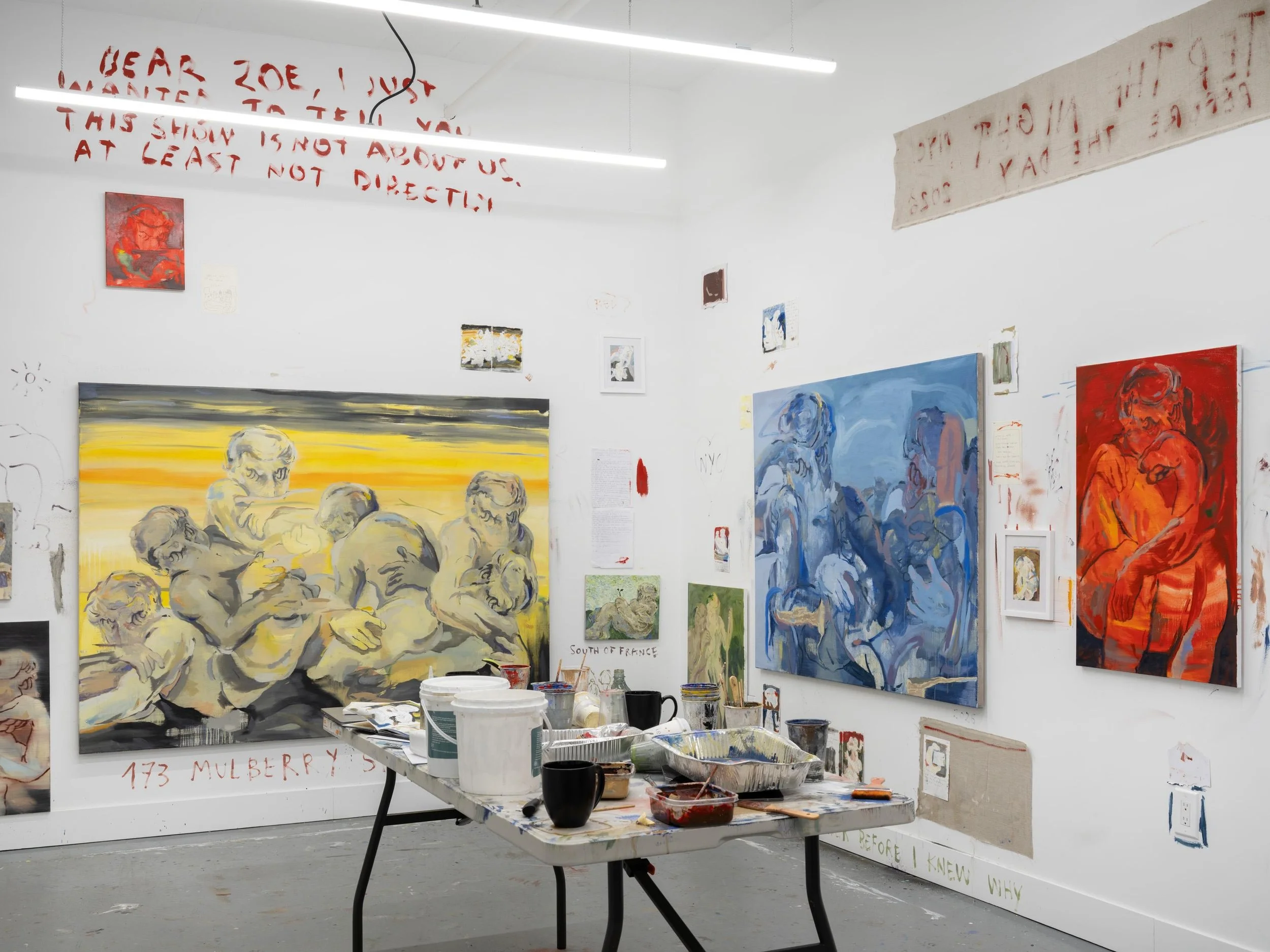
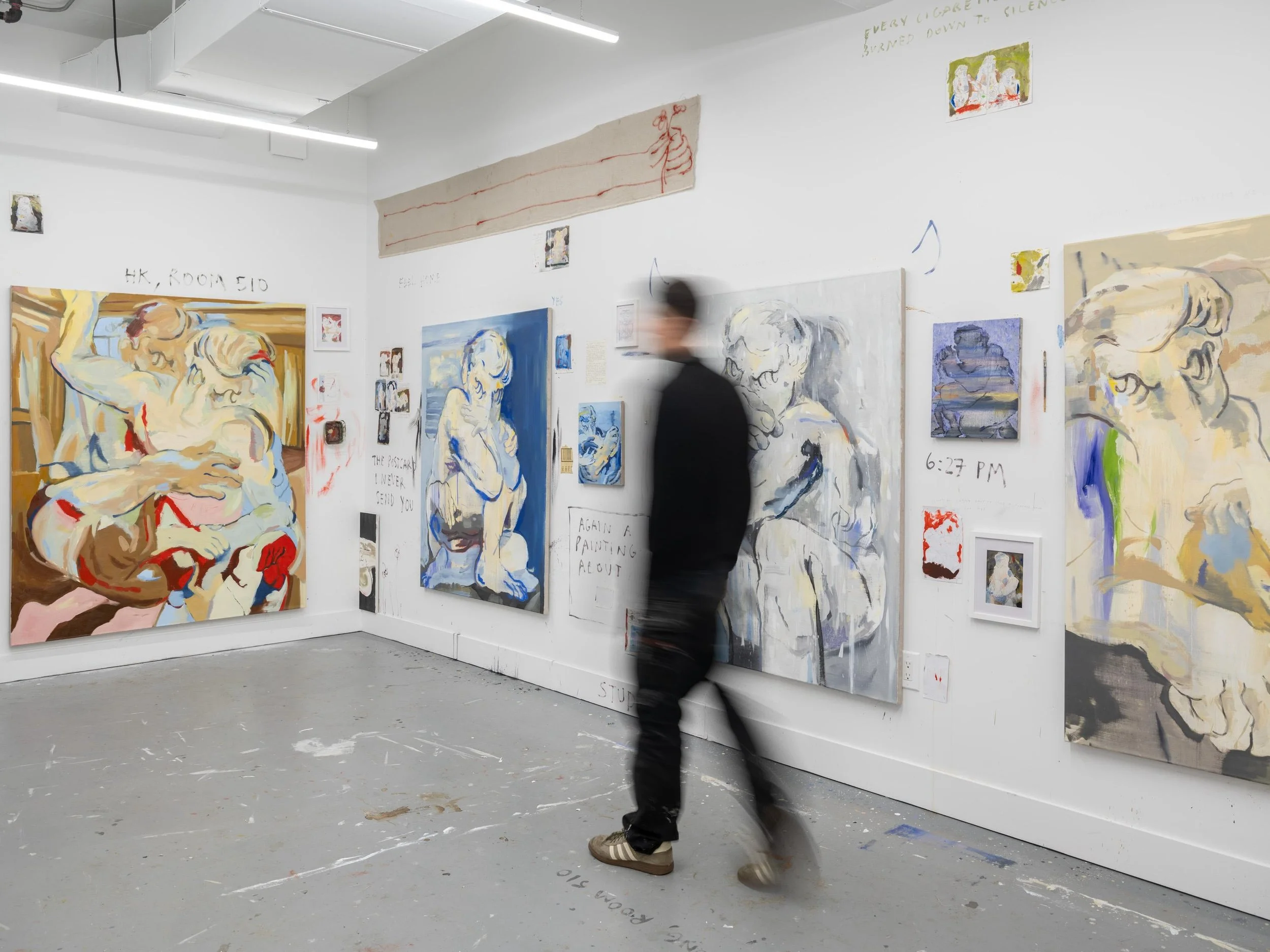
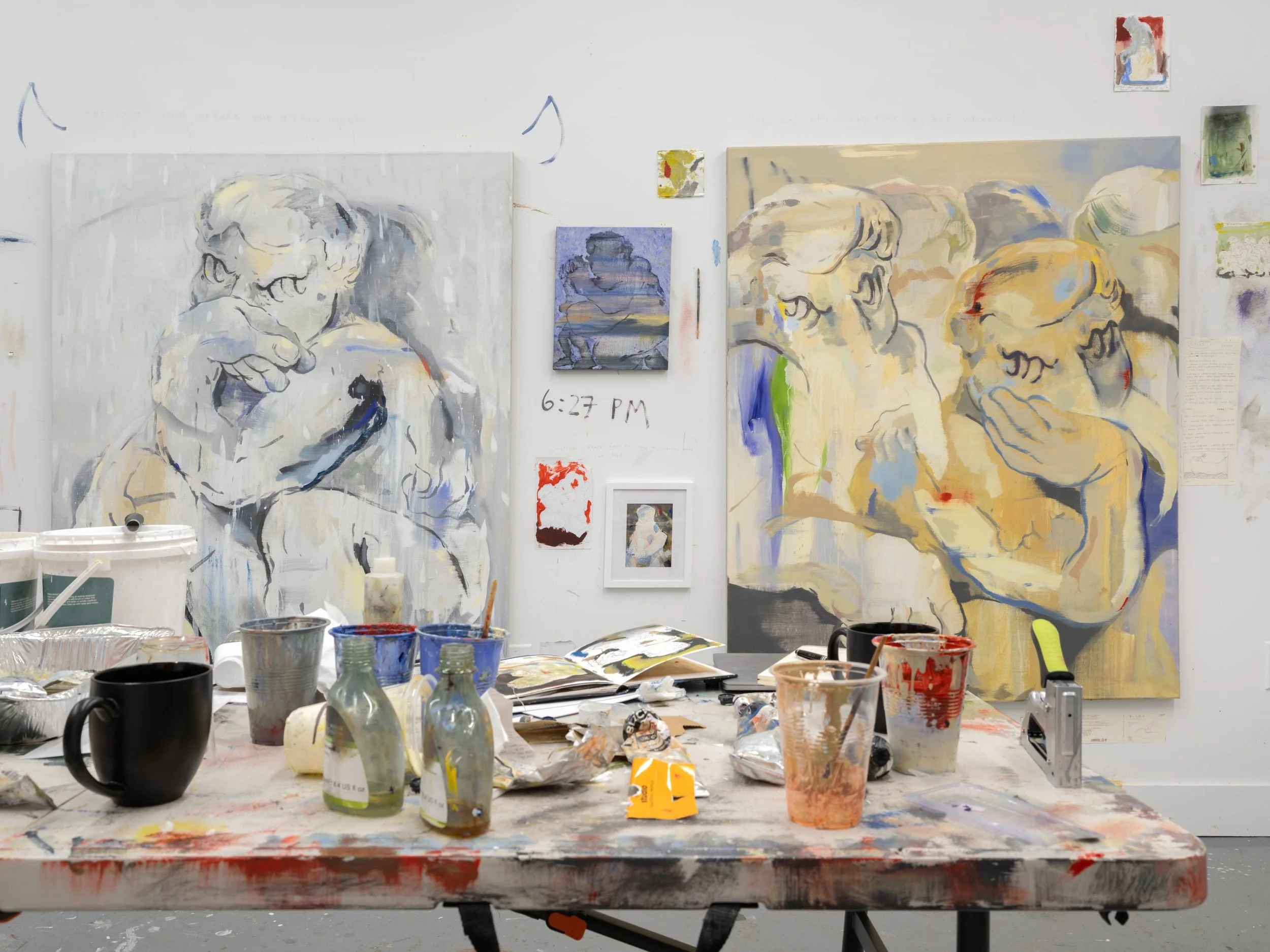
I am not interested in clarity. I am interested in instability. The threshold between figuration and abstraction is where meaning starts to slip, where the image resists being consumed too quickly. If something is fully legible, it becomes decorative. If it dissolves too much, it becomes evasive.
I let images fracture when they start to feel too confident. When the figure asserts itself too strongly, I break it, multiply it, or blur its logic. I want the viewer to hesitate, to question what they are looking at, and by extension, how they look. That hesitation is the real subject of the work.
Saturated colour and layered symbols play a central role in your practice. Can you talk about how colour functions psychologically or narratively in your work, and how you build meaning through accumulation and excess?
Colour is never descriptive in my work. It is emotional pressure. Saturated colour compresses space, time, and feeling into a single surface. Red, in particular, is not symbolic for me; it is physiological. It activates something immediate, almost violent, before thought arrives.
Accumulation and excess are ways of mimicking lived experience. Memory doesn’t arrive cleanly, it arrives in fragments, repetitions, overlays. By layering symbols and forms, I’m not trying to explain a story, but to recreate the sensation of being inside one, where too much is happening at once and nothing fully resolves.
You have described your process as alchemical, transforming familiar icons into luminous yet fragile forms. What does “collapse” look like in your studio practice? Does it emerge through material failure, conceptual doubt, or intentional disruption?
Collapse is not an accident in my studio, it is a condition. It usually begins with excess: too much color, too many figures, too much emotional charge. I push the image until it starts to resist me. At that point, something gives way. Sometimes it is material, the surface becomes unstable, the paint refuses to hold. Other times it is conceptual, the image stops making sense in the way I expected.
I allow that moment to happen. Collapse is where the painting detaches from intention and becomes autonomous. It is no longer illustrating an idea but exposing its fragility. What remains is often quieter, more vulnerable, but also more precise. That is the point where the work begins to feel alive.
As your work circulates between different cities, institutions, and art fairs, how do you see your practice evolving in response to scale, audience, and context? What questions are you currently trying to push further in the studio?
Circulating between different contexts has made me more aware of how a painting behaves once it leaves the studio. Scale, for me, is no longer just a formal decision but a way of addressing time and attention. Large works operate almost physically; they slow the viewer down, they insist. Smaller works demand proximity and intimacy. I think a lot about how these formats speak differently depending on where they are shown, without changing their core language.
At the same time, I try to protect the work from adapting too much to audience or expectation. Institutions, fairs, and galleries all impose different rhythms, but I see my role as maintaining a certain instability within those frameworks. I am not interested in clarity or resolution. I want the paintings to remain slightly resistant, regardless of context.
In the studio right now, I am pushing questions of repetition and fragmentation. The figure no longer exists as a single presence but as a sequence, a group, a delay. I am interested in how an image can carry several moments at once, how identity can multiply without becoming narrative. The challenge is to let the work evolve in scale and ambition while keeping its emotional risk intact.