Interview with Peter Lynch
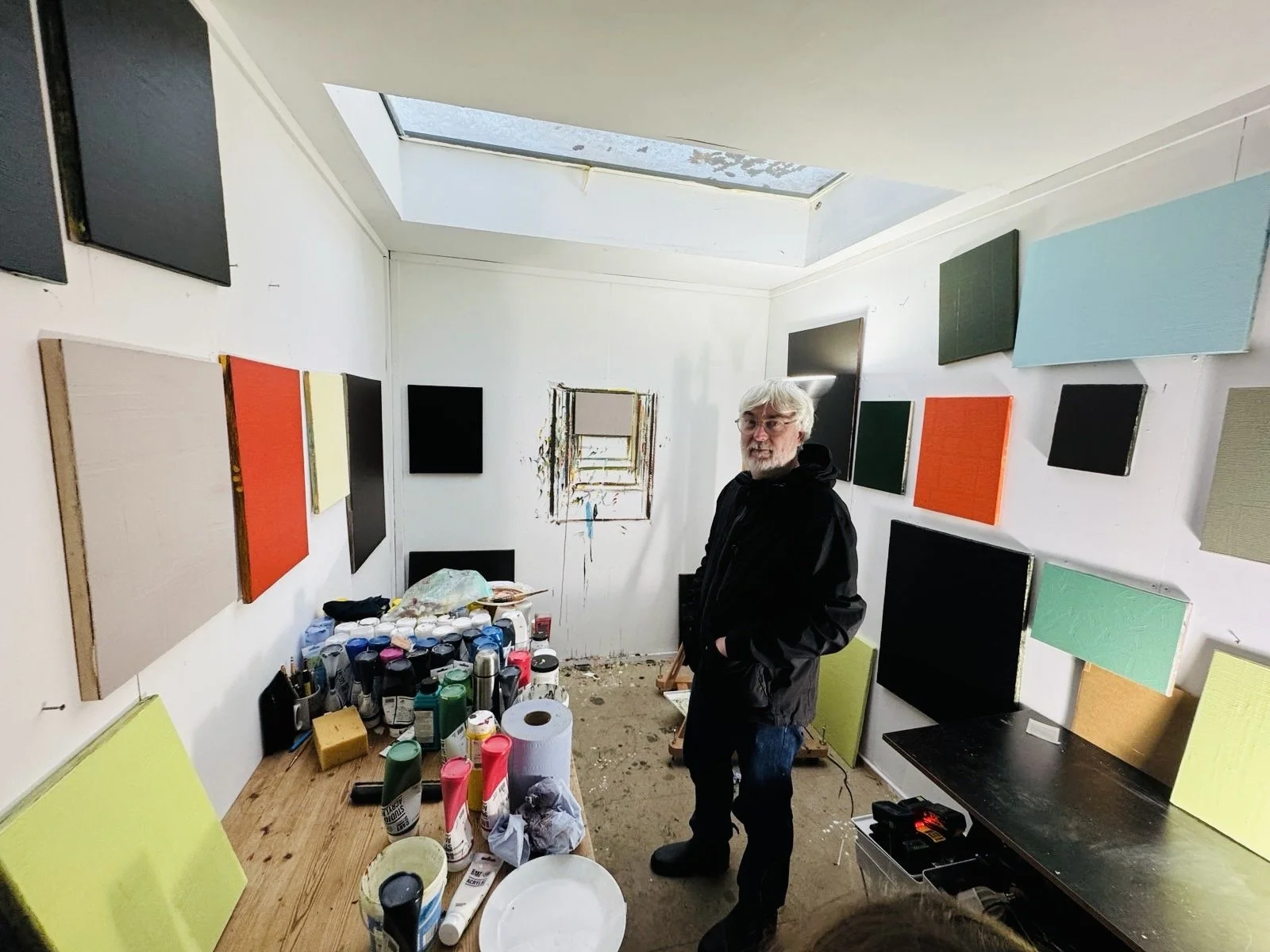
Peter Lynch (b. 1971, United Kingdom) is a contemporary visual artist based in London, known for his abstract paintings and works on paper. His practice focuses on exploring the tension between gesture and control within the act of painting.
Lynch’s work often features layered surfaces where paint is repeatedly applied and partially erased, leaving traces of earlier marks visible. A distinctive element of his style is the use of finger marks and repetitive brush gestures, which interrupt otherwise uniform surfaces and create a dialogue between spontaneity and structure.
His paintings are typically monochromatic or minimal in palette, emphasizing texture, surface history, and the physical process of making the artwork. Rather than depicting external subjects, his work reflects on painting itself—how marks accumulate, disappear, and persist over time.
Lynch has exhibited internationally, with shows in cities such as London, New York, San Francisco, Basel, and Venice, and continues to produce both canvas paintings and watercolors
INTERVIEW WITH PETER LYNCH AND LAURA DAY WEBB
What first drew you to the visual arts, and was there a defining moment or influence that set you on the path to becoming an artist?
My earliest visual memories: My parents had the most amazing carpet in the 1980s; it was bold and abstract, and I was fascinated by how the repeated pattern was almost impossible to decipher.
They also had a reproduction of Constable’s The Cornfield, a painting full of a quiet narrative as well as unknown within the paint. I am still amazing how a static / frozen in time can invoke so may possibilities
Later In art class at school, three of my classmates, we created a bit of a gang, found a camaraderie around art, and in the end, each of us followed our own paths, all of us ended up going to different art school in different parts of the country. Even though we have lost contact they were essential in defining my future path.
During your formative years at Glasgow School of Art, under the guidance of Callum Innes and in the company of contemporaries such as Hayley Topkins, Sue Topkins, and Jim Lambie, how did your engagement with color, tactility, and the nature of the painted surface begin to take shape?
At a certain point in art school, I started to look at degrading painting. Using the detritus in the bucket for cleaning brushes, I started to paint with the residue. Once this paint was applied, I removed lumps with my finger, creating small gestures within the painted surface.
This was an interesting starting point—to an extent, the birth of the practice. Color, or the corrosion of color; gray paintings with the combination of the finger as a form of physical gesture. At the time, there was (and continues to be) a conversation that painting was dead; to some extent, I was trying to produce "dead painting."
Your recent paintings emerge through a meticulous layering and subtraction of colour, creating subtle shifts and suspended stasis. Could you describe how a work typically develops in the studio, from initial conception to the resolution of surface and texture?
What is important for me is that I have no particular notion of what the painting will become when starting it. I usually paint in batches, working with perhaps 10–15 at one time.
I have three different forms of production I use: paint applied by brush, paint applied by roller, and paint removed by the finger. Within these three forms of production, a painting is born. Initially, they are quite arbitrary, but as the painting develops, they become more and more defined until they reach a point of completion.
Within the process, there is also color. Again, the choice of color starts arbitrarily; as more layers are added, the specific color becomes more defined. The color palette is often muted, playing with the corrosion of the primaries.
Much of your work investigates the tension between presence and absence, between expressive mark and restraint. How has your approach to bodily gesture in painting evolved, particularly in relation to your early experiments with grids and structure?
The finger mark, often embedded within the surface, is almost primordial—the most basic human gesture. However, because of the small scale of the paintings, the gesture is limited and contained within the framework of the canvas. The finger marks within the surface are more often vertical and horizontal, restricting the gesture and refraining from being expressionistic.
Your titles, such as Keep an Eye on the Mirror, often introduce a deliberate ambiguity. How do you see them functioning alongside the work, and in what ways do they shape or challenge the viewer’s perception of your paintings?
The titles are important. The paintings themselves are not specific, and although for me they are pure abstraction, as an artist, I do not want to restrict their interpretation. The paintings exist in their own right, outside of the artist, existing to develop their own dialogue and interpretations.
Your largest solo exhibition in North America now on at Sandler Hudson Gallery through April 11, brings together an immersive assemblage of paintings and works on paper. As the artist, how do you experience this body of work when it is presented in the gallery, and what responses or encounters do you hope it evokes in viewers?
For me, it is important that the viewer experiences the works both as a group and as individuals. The installation is essential in allowing this to happen; harmonies and discourse begin to occur. Of course, there is more than one solution to achieve this, and the installation process is a creative process in itself. However, compared to the production of the artwork—which is more often than not a singular process—installation is often communal, with curators and galleries presenting alternative views. For the viewer, I want them to be allowed to look at the works without the confines of linguistic interpretation—that they view them openly and are allowed to see them through their own eyes rather than the artist’s.
As your practice continues to develop, what directions, questions, or materials are you most drawn to exploring in the future, and how do you envision your work evolving in the years ahead?
At the moment, there are a number of things I have been wanting to explore: watercolor as a medium, the scale of the paintings, and a series of sculptural paintings that I produced previously.
However, within the paintings themselves, I feel there are more avenues to follow within the restrictions I have given myself to produce the works. I do not see my art practice as a linear progression, but instead as something often circular, going back to aspects of the practice that I may have touched on briefly and returning to them in more detail. Along the way, pitfalls and dead ends are found. Sometimes there is a need to work through them, sometimes over them, and sometimes circumnavigate them, but these barriers and failures need to be embraced and taken as positives to enrich the practice.
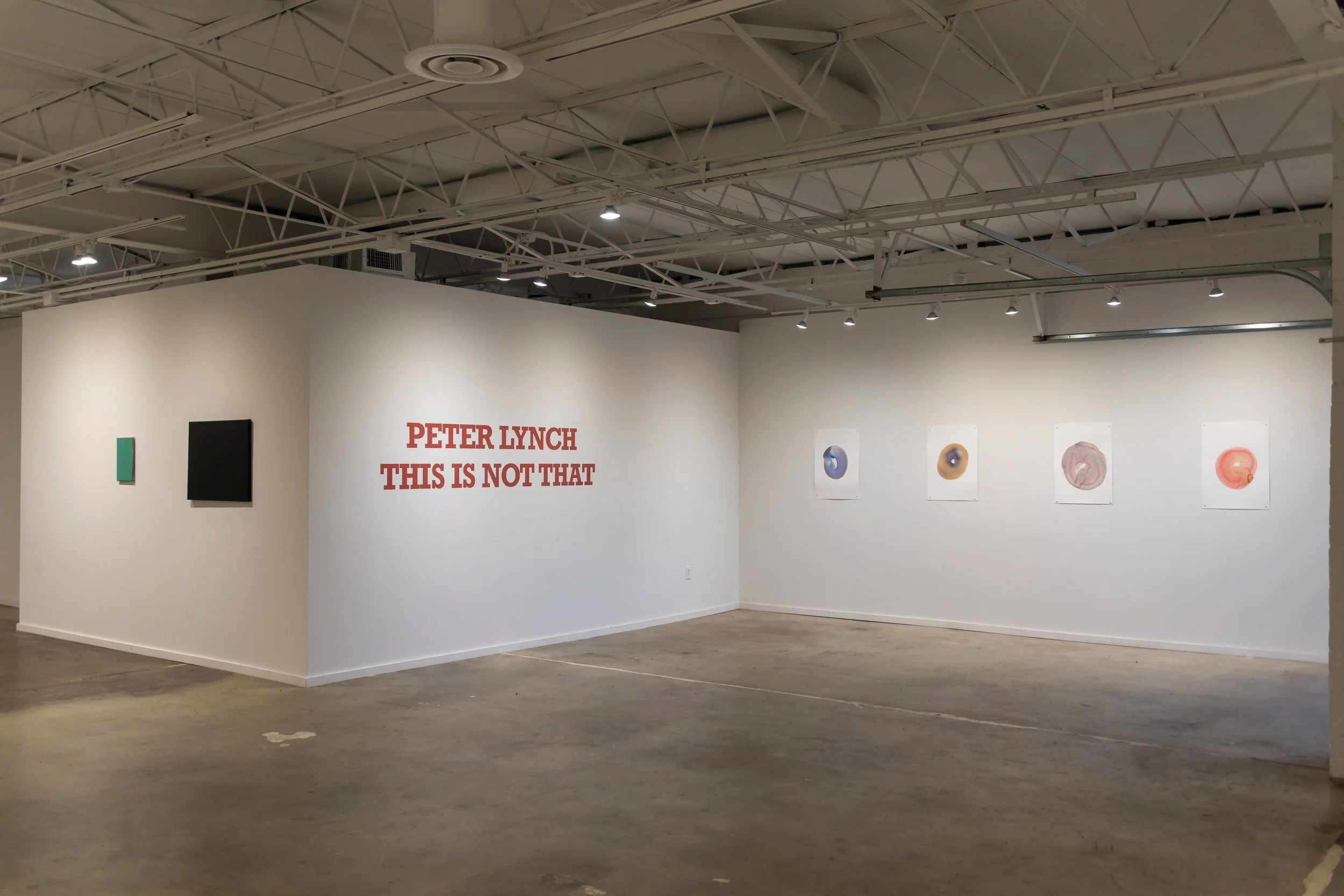
Installation view, Sandler Hudson Gallery (enlarged watercolours)
SELECTED WORKS

Peter Lynch
keep an eye on the mirror, 2025
acrylic on linen
80 x 60 x 2 cm

Peter Lynch
To me it seems like folly, 2025
acrylic on linen
61 x 45.7 x 0.8 cm
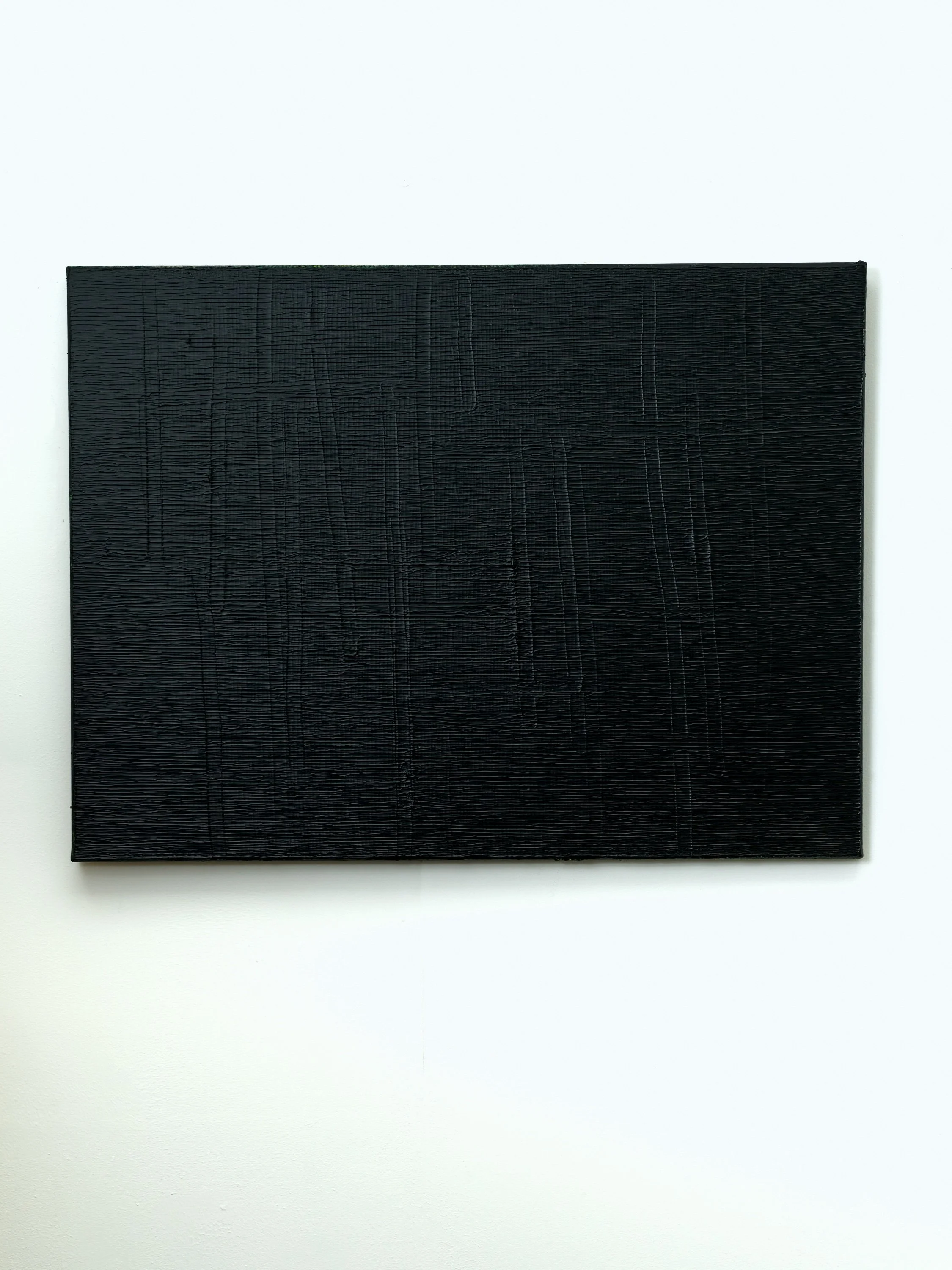
Peter Lynch
left baffled and mystified, 2024
acrylic on linen
80 x 60 x 2 cm