Interview with Piper Bangs
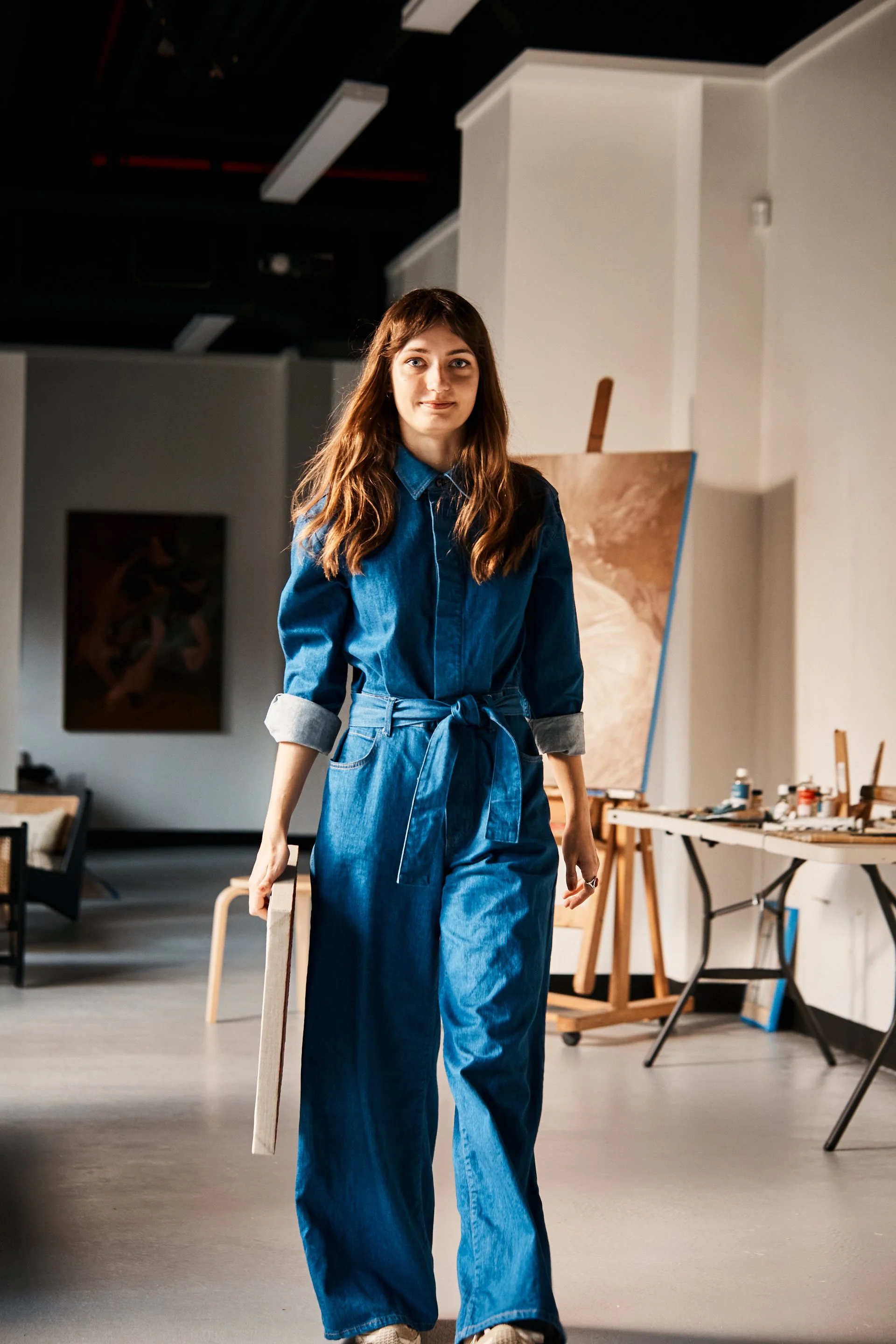
Piper Bangs (b. 2002 in San Antonio, TX; lives and works in Los Angeles, CA) is a painter who earned her BFA in Drawing and Painting at Laguna College of Art and Design in 2024. Bangs has had solo exhibitions at Megan Mulrooney Gallery in Los Angeles, CA, HdM Gallery in Beijing, China, and the Watermill Center in Watermill, NY. She will be an artist in residence at the Mack Art Foundation this winter, and has exhibited her work in venues such as Sehwa Art Museum in Seoul, South Korea, Uffner & Liu Gallery in New York, NY, The Pit in Palm Springs, CA, and The Contemporary at Blue Star in San Antonio, Texas, among others.
This interview is in partnership with The Mack Art Foundation Residency program who supports emerging artists, offering immersion in the New York City’s art and culture. The program aims to broaden artists' perspectives and connects them with galleries, curators, and collectors.
mackartfoundation.org
INTERVIEW WITH PIPER BANGS BY LAURA DAY WEBB
What first drew you to art and when did painting begin to feel like a serious vocation for you?
I remember being unable to stop looking at a John Singer Sargent painting at the San Antonio Museum of Art. What pulled me into the painting was the lush, fresh paint handling that seemed to perfectly fall into place. What I remember most from looking at that painting over and over was thinking to myself that I wanted to learn how to make paint click into place in that way.
After learning technical painting for several years, I also got to go to YoungArts Miami, where we students went on a wonderful guided tour of the Pérez Art Museum. It was my first introduction to a way of looking at conceptual art. The guide’s process was basically to ask ourselves what we saw in front of us in detail and what it reminded us of. I’m so grateful I had that introduction because, as someone deeply interested in both subject matter and paint, it gave me a way to think critically about the content of a work in addition to its fabrication.
After that, art suddenly opened up as something that felt infinite in what one could pursue, both materially and conceptually.
There were certainly stages of it becoming more and more serious over time. It started when I was a young teenager and extremely hungry to learn observational painting. I stole as many hours of the day as I could to paint.
Later on, I began structuring my life around making paintings instead of structuring making paintings around my life. That looked like waking up at five so I could paint for four hours before classes in college, spending my lunch breaks painting, and then returning to the studio again in the evening. It was heaven then, and it’s still heaven that this gets to be how I spend my days.
Your paintings often feature biomorphic forms that seem emotionally charged and psychologically alive. How do these forms emerge in your process, and what kinds of internal narratives are you exploring through them?
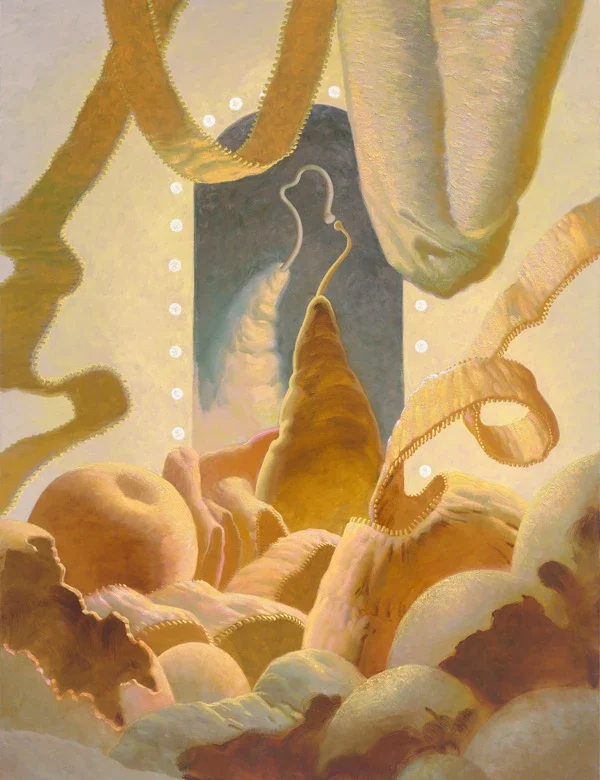
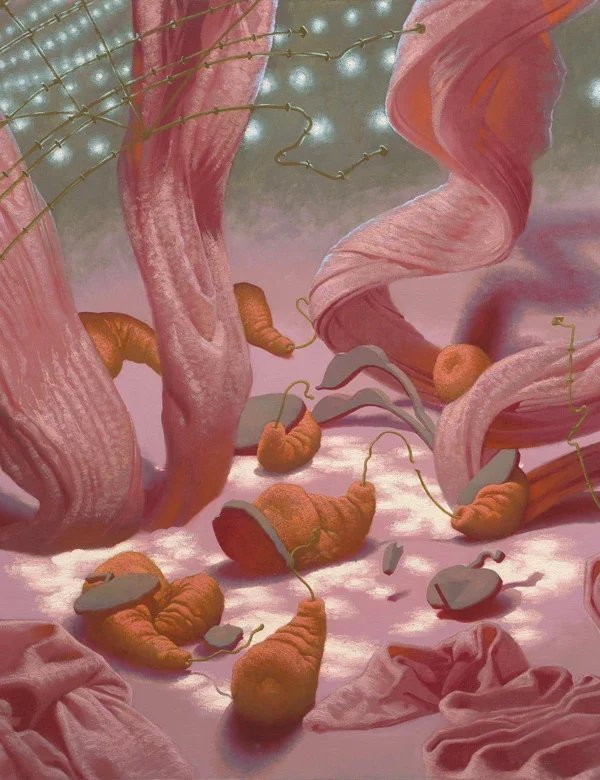
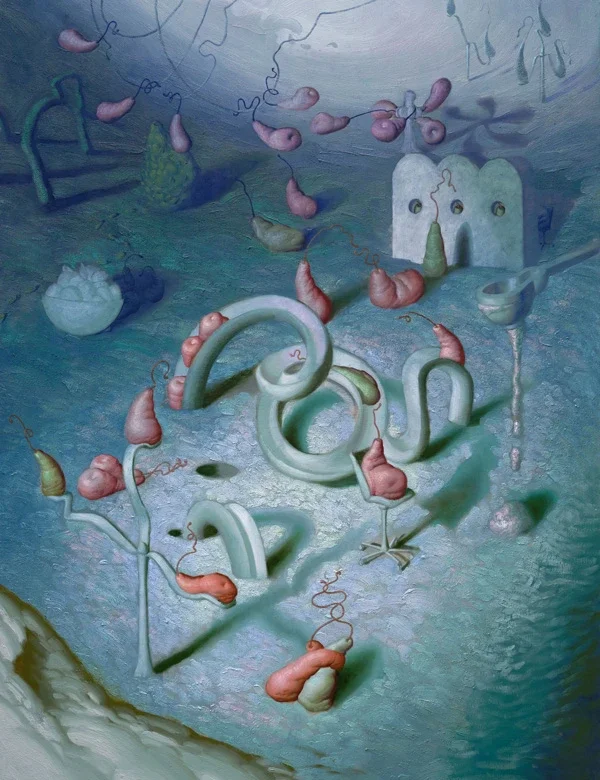
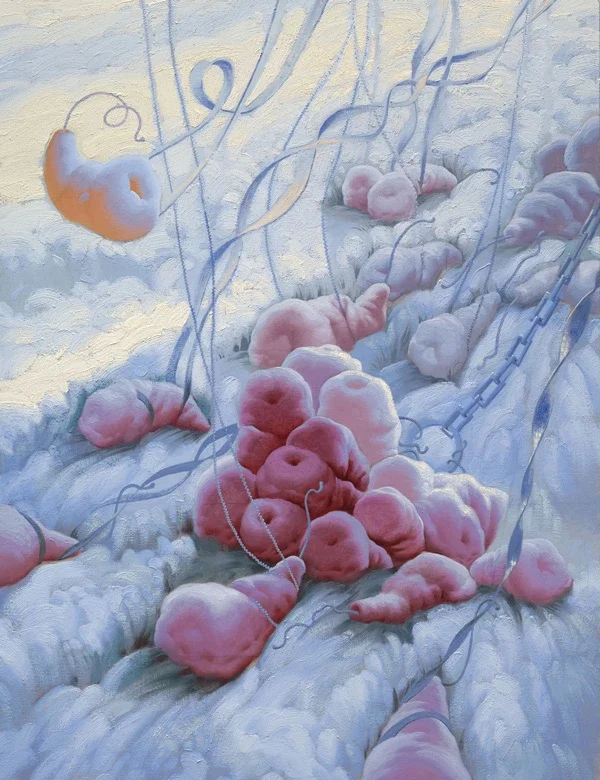
The origin of the fruit figures came from a quote by Renoir where he said that his goal in painting the nude was to “paint them as beautiful fruit.” I thought this was funny and peculiar—the way it treats the body as something decorative and consumable—and I wanted to parody and pay homage to this by creating my own kind of fruit figure. Over time, though, those figures have moved away from being only a critique and have become characters that allow me to explore vulnerability, tenderness, and relationships.
For how these forms emerge in my process, I would say that I begin all of my paintings through lots of writing about painting and life. Moments or stories that were tender and/or uncomfortable tend to lead me toward ideas for paintings.
Right now I’m interested in ordinary moments of connection that also have a tense or precarious undercurrent where there’s some risk involved—telling someone you love them for the very first time, the labor involved in an act of service received or given, and vulnerability that risks rejection, for example. I hope the figures contain closeness, awkwardness, uncertainty, comfort, or ambivalence without necessarily needing a clear narrative.
I hope that a lot of the emotion comes through what I think of as “skin events”—things like sunburns, goosebumps, pushes and pulls on flesh where one figure meets another, cellulite, flesh folds, etc.
In the process of translating these stories into the world of these fruit figures, I hope they become more open-ended for viewers, leaving room for people to bring their own thoughts about what’s happening in the painting to the work.
Your work draws from 19th-century academic painting, Rococo ornamentation, and Dutch Golden Age painting. What attracts you to these historical visual languages, and how do you reinterpret them through a contemporary lens?
On the technical side, I was initially drawn to the gorgeous light and illusionistic handling of paint in these kinds of painting. I also love that with the historical paint materials I’ve been using, there is such breadth and complexity in what the materials can do.
For 19th-century academic painting, I like that there were so many rules imposed on the paintings being made. I think those rules are rife with opportunities to play with them and turn them on their head in a way that makes more sense for our time. That’s part of why I also love the medium of oil painting. Beyond loving the material itself, adopting technical methods from the past feels like an opportunity to be in dialogue—to have a conversation in the same language—with painters across the long continuum of people who have used the medium.
Alongside this, there are through-lines between the cultural attitudes embedded in these historical paintings and the ones we still hold today. I hope to use this format to think through what's on my mind now, both culturally and personally.
I can’t stop thinking about contemporary ideas of masculinity and how they’re shifting alongside broader conversations about feminism and gender equality. I’m curious what emotional lives become possible for men as those expectations change. Showing compassion and trying to understand the struggles of the men I’m close to is something I think about often, especially the ways many have been culturally brought up to withhold vulnerability or emotional openness.
People have often pointed out that the fruit figures can look phallic, and I’m interested in leaning into that. As I’ve been borrowing compositions from allegorical paintings that originally depicted violence, I’ve become curious about what happens if those same phallic figures instead express softness, affection, and everyday intimacy.
Right now another particular thread is the French academic painting hierarchy that prized allegorical and grand manner portrait painting over landscape and domestic still life painting. I’m interested in parodying and paying homage to that system by borrowing compositions from Old Master paintings—especially paintings built around tumultuous or violent scenes, like Veronese’s Martyrdom of St. Sebastian—and inserting scenes of tenderness with emotional stakes in their place.
Similarly, I’ve been looking at Delacroix’s Women of Algiers as the basis for a painting about sisters sharing a secret and closing a door to create a private, intimate space.
Your work challenges dominant narratives around girlhood, gender, and sex without feeling purely autobiographical or illustrative. How do you navigate the line between personal experience and broader cultural commentary when constructing these worlds and figures?
This is a reason I enjoy using these fruit figures as a stand-in for human figures in my paintings.
I hope that there is a remixing or scrambling process that occurs when I attempt to base a painting off of autobiographical details and use the fruit figures in this way. I hope that there are small landmarks that provide enough detail to guide a painting, but not so much that it squashes any other ideas one may have about what’s going on in it.
Color, light, and atmosphere are also part of bridging personal experience and something broader for me. I’m often looking for the emotion underlying something, and hopefully that’s what pulls it closer to something universal.
Of course, often our personal lives are microcosms of what’s unfolding in the culture more broadly, so pulling from my own life and those around me often brings me to thinking about broader themes.
Your work creates a kind of parallel mythology built from recurring forms and archetypes. Do these characters evolve organically from painting to painting, or do you think of them as inhabiting a shared world?
The narrative changes from painting to painting, and between bodies of work more broadly, but I do think of these figures as inhabiting a shared world that slowly evolves over time.
Certain things remain consistent between paintings: the fruit figures themselves, the landscapes they inhabit, the way I think about light, and even the way I approach paint, though all of these continue to change gradually.
The figures’ bodies have started to change in my recent paintings. I’ve become more interested in the physical texture of the skin contributing to the narrative of a painting.
I also think about paint handling as part of building a world within the work. For years I’ve been using what I think of as a “hierarchy of texture,” where areas of light tend to have thick, impasto passages of paint while darker passages remain thinner and more transparent, but I’ve been leaning into using a lot more physical texture in larger swaths of the paintings in order to make the fruit figures especially smooth and fleshy recently.
Different motifs also emerge and disappear over time. In 2024 I often included an anthropomorphic, lumpy, cellulite-coded tree and strings of pearls as a way of describing communication and support networks between people. As the work evolves, some motifs fall away while others return in different forms and new ones come about.
You have already exhibited internationally. How has showing your work in different cultural contexts shaped the way you think about audience, symbolism, or interpretation?
It’s been really interesting to think about how cultural touchpoints are different for each place the paintings exist in. For example, when I was making paintings for my solo exhibition with HdM Gallery in Beijing, I became more familiar with the fact that because the visual canon many viewers there are familiar with is, of course, different from the Western canon I’m often referencing, viewers there were expected to primarily read the figures as fruit with a somewhat sexual undertone rather than also as a parody of the nude in parts of Western painting.
It’s something I like to be aware of, but not something I want to change the work around. If anything, it has made me appreciate that the paintings can sustain different readings depending on who is looking at them. I hope they stay open enough that viewers from different cultural backgrounds can enter them from different places without the paintings taking on one fixed reading.
SELECTED WORKS